Quick Summary
To choose a cgm armband that stays secure, first confirm it fits your exact sensor model, then measure your upper arm at the sensor site, not the bicep peak. Pick a breathable band for daily wear and a firmer, water-resistant one for swimming or heavy work.
- Standard CGM sensor wear time is 14 to 15 days, according to a University of Kansas journal guide.
- Clinical guidance favors the upper arm for adults, where most armbands are designed to sit.
- Measure arm circumference at the sensor site, ideally at the time of day you usually wear the band.
- Signs of too much compression include visible marks, tingling, numbness or cool skin below the band.
- Remove and dry the band after heavy sweating or swimming, and rotate two bands so one can dry.
Table of Contents
- What a CGM Armband Does and Who Needs One
- Check Sensor Compatibility and Placement First
- CGM Armband Sizing: How to Measure and Test Fit
- Materials, Breathability, and Skin Sensitivity
- CGM Armband for Exercise, Swimming, and Physical Work
- How to Keep a CGM Sensor On Without Hurting Accuracy
- Your Next Step: Measure, Match, and Order the Right Size
- Frequently Asked Questions
What a CGM Armband Does and Who Needs One
A CGM armband is a band designed to help secure a continuous glucose monitor sensor. For people who wear a CGM through workouts, workdays or water activities, an armband can provide an additional layer of physical security.
Sensors are designed to last a set period. Standard CGM sensor wear time is 14 to 15 days, according to a University of Kansas journal guide on choosing a continuous glucose monitor. When a sensor peels early, the user typically has to replace it before the period is up, which adds cost and interrupts glucose data. That gap is the problem an armband is meant to close.
Armbands are designed for people who want added sensor security during daily activities, including exercise, school or play, and physically demanding work.
Check Sensor Compatibility and Placement First
Before buying any armband, confirm it fits your specific sensor model. Sensor shapes, sizes and transmitter positions differ, and a band designed for one model may not sit correctly on another. Check the product listing for your exact sensor before ordering.
Placement matters as much as compatibility. Clinical guidance now favors the upper arm for adults, which is where most armbands are designed to sit. University of Arkansas for Medical Sciences provider guide on CGM placement reflects this standard. Placing the sensor on a spot with more movement or skin folds can reduce retention, even with a band. For step-by-step help with a peeling sensor, read the proven fixes for sensor peeling. Compare protective gear options for keeping Libre sensors secure.
Match the band to the device before anything else.
CGM Armband Sizing: How to Measure and Test Fit
Sizing an armband is not the same as sizing a shirt. The band has to sit over a specific sensor at a specific spot on the upper arm, so the measurement that matters is the circumference of the arm at the sensor site, not your bicep peak, not your body weight, and not your age.
Measure at the sensor site, not the bicep
Arm circumference changes with swelling, training, and time of day, so measure at the same time of day you will usually wear the band. A common pattern is to measure twice, once in the morning and once after activity, and pick a size that fits both.
Compatibility by sensor model and placement
A simple compatibility check: lay the band flat, place your sensor (or the applicator’s outline) on top, and confirm the band’s opening lines up with the sensor’s footprint. If the opening is too small, the band will press on the device; if it is too large, the sensor can shift under the fabric.
Objective fit and performance tests
If the band is too loose, it will slide and let the sensor lift at the edges. If it is too tight, it can restrict circulation and irritate the skin. The right fit is snug enough to hold the sensor’s edges down and loose enough that you forget it is there.
Materials, Breathability, and Skin Sensitivity
Most armbands are sold on fit and hold, but the material is what determines whether you can wear the band for 14 days without irritation. Fabric, seams, compression, and trapped moisture all interact with the sensor adhesive and with your skin.
What each material does well, and where it fails
A common pattern is a breathable knit for daily wear and a firmer, water-resistant band for swimming or heavy work, rather than one band for every situation.
Seams, edges, and compression
Compression is a separate issue. An armband should hold the sensor’s edges down, not squeeze the arm. Signs of too much compression include:
- Marks that stay visible for more than a few minutes after removal.
- Tingling, numbness, or cool skin below the band.
- A band that leaves a deep groove even when you are not active.
If you have a circulation condition, lymphedema, or a clinician’s instruction to avoid pressure on the arm, talk to your care team before wearing a compression-style band.
Moisture management and skin sensitivity
Practical steps:
- Choose a moisture-wicking fabric for daily wear and a quick-drying band for swimming.
- Remove the band after heavy sweating or swimming, rinse it, and let it dry fully before putting it back on.
- Pat the skin dry under the band before re-wearing it.
- Rotate between two bands so one can dry while the other is worn.
Cleaning and when to replace
A band that has lost its hold is no longer protecting the sensor, and a worn band can also rub or trap moisture. Treat replacement as part of the wear cycle, not an afterthought.
The table below summarises how the material choice affects comfort and sensor adhesion, so you can match the band to your daily routine.
| Use case | Band type | Key difference |
|---|---|---|
| Daily wear | Breathable knit | Moisture-wicking fabric |
| Swimming or heavy work | Firmer, water-resistant band | Quick-drying, holds sensor edges |
| Between wears | Two bands rotated | One dries while the other is worn |
CGM Armband for Exercise, Swimming, and Physical Work
Libre Shield’s armbands are designed to provide sensor security during physical activities.
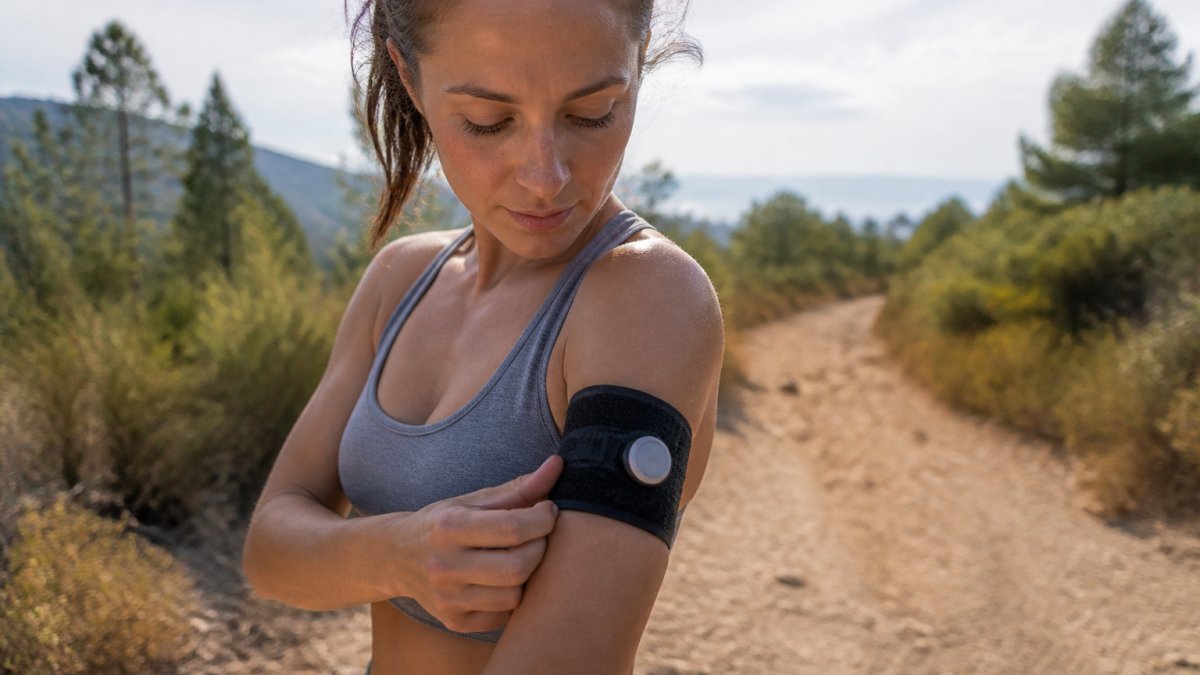
For physical work, a band reduces the risk of catching the sensor on equipment or door frames. Positioning matters here too. Keep the sensor out of the area where tools, straps or loads press against the arm.
How to Keep a CGM Sensor On Without Hurting Accuracy
Remember that CGM devices require replacement every 7 to 14 days, according to the CDC guidance on continuous glucose monitors. Your armband should support the full wear period, not extend it past the manufacturer’s limit.
For more options on keeping sensors secure, see [Best Protective Gear for Libre Sensors: 2026 Guide] and [How to Stop CGM Sensor Peeling Off: 7 Proven Fixes].
Your Next Step: Measure, Match, and Order the Right Size
Libre Shield provides specialized sensor saver armbands designed to offer sensor security and protection during daily activities. Check Libre Shield’s website for current product information.
Frequently Asked Questions
How do I choose the right size CGM armband?
Measure the circumference of your upper arm at the point where your sensor sits, usually about halfway between the shoulder and elbow. Compare that measurement to the size chart for the armband you are considering, and check whether the sizing is listed in centimeters or inches. Choose the size that fits snugly without pinching or cutting into the skin. Test the fit by raising your arm overhead and bending your elbow, then confirm the sensor stays covered and flat. If you are between sizes, consider the activities you do most, since an active lifestyle often calls for a snugger fit.
How tight should a CGM armband fit?
A CGM armband should feel secure but not restrictive. You should be able to slide one finger under the edge without strain, and the band should not leave deep marks or cause numbness after an hour of wear. The sensor should stay pressed flat against the skin with no gaps. Recheck the fit after a day of normal activity, because skin changes and sweat can alter how the band sits. Breathable, stretchable materials help maintain comfort at a snug fit.
Can you wear a CGM armband while exercising?
Libre Shield’s armbands are designed to provide sensor security during physical activities.
Will an armband interfere with CGM readings or alarms?
A properly fitted armband should not block the sensor’s connection to your reader or phone, but the wrong fit or material can cause problems. Pressure on the sensor, excess moisture, or adhesive from a cover can affect wear and comfort. Clinical guidance stresses that users should understand factors that affect sensor accuracy. If you notice readings that do not match how you feel or a sensor that seems damaged, check the sensor site, follow your device instructions, and contact your diabetes care team.
How do you keep a CGM sensor from falling off?
A Libre Shield armband is designed to provide sensor security during daily activities.
Can you sleep comfortably while wearing a CGM armband?
Many users sleep with an armband in place, but comfort depends on fit and material. Choose a soft, breathable band that does not dig in when you lie on your arm. Loosen the band slightly if you notice tingling or pressure overnight. Keep in mind that sleep position matters, so a band that works well when you sleep on your back may feel different on your side. Check the sensor in the morning to confirm it is still secure.
How often should you wash a CGM armband?
Check the Libre Shield website for current pricing information.
Are CGM armbands compatible with every sensor?
Libre Shield provides specialized sensor saver armbands designed for continuous glucose monitoring sensors. Check Libre Shield’s website for current product information.
