Quick Summary
The most durable CGM armband resists fabric stretch, closure loosening and sensor edge lift during heavy activity. For CrossFit, a flat closure, low-profile seam and mid-upper-arm placement matter most, since they keep the band out of the bar path. Drying speed also counts after heavy sweating.
- Durability depends on material, fastening system and how well the band holds the sensor against skin.
- Pool chlorine and saltwater stress fabrics, so rinse and air-dry armbands after every swim.
- Measure mid-upper-arm circumference and choose a size near the middle of its stated range.
- Place the band slightly posterior and mid-arm to stay out of the bar path and rope contact.
- Confirm your sensor model’s water-resistance rating, since it applies to the sensor, not the armband.
Table of Contents
- Which CGM Armbands Are the Most Durable for Heavy Swimming and CrossFit?
- How We Judge Durability: Criteria for Swimming and CrossFit
- CGM Armband for Swimming: Saltwater, Chlorine and Freshwater Performance
- CGM Sensor Protection for CrossFit: Friction, Sweat and High-Impact Movement
- How to Keep a CGM Sensor On While Swimming
- CGM Armband Fit and Sizing: Placement, Circulation and Comfort
- Your Next Step: Choosing an Armband and Checking Sensor Water Ratings
- Frequently Asked Questions
Which CGM sensor armbands are the most durable for heavy swimming and CrossFit?
Last Updated: November 1, 2026
[Opening placeholder removed for drafting clarity]
Last Updated: November 1, 2026
Which CGM Armbands Are the Most Durable for Heavy Swimming and CrossFit?
Durability for a CGM armband depends on the material, the fastening system and how well the armband holds the sensor against the skin. A good armband should stay in place through sweat, pool water and repeated friction, while leaving the sensor’s adhesive and water-resistance ratings intact.
Sensor saver armbands are designed for people who need their CGM to stay put during active days. The question is less about a single “best” product and more about which features matter for your workouts and your sensor model.
The FreeStyle Libre 3 Plus is reported to withstand immersion in up to 3 feet of water for up to 30 minutes (Type1Strong review of CGM water resistance). That rating applies to the sensor itself, not to the armband, so the two should be evaluated separately.
How We Judge Durability: Criteria for Swimming and CrossFit
Most armbands fail in one of three ways: the fabric stretches, the closure loosens, or the sensor edge lifts. We look at each of these when judging durability.
Watch for these criteria when comparing options:
- Fabric recovery: Does the material return to shape after a long swim or a heavy set?
- Closure security: Does the fastening hold during burpees, rope climbs and barbell work?
- Water tolerance: Can the material handle chlorine, saltwater and repeated soaking without breaking down?
- Sensor retention: Does the armband keep the sensor flat and in contact with the skin?
CGM Armband for Swimming: Saltwater, Chlorine and Freshwater Performance
Pool water and saltwater both stress fabrics and elastics over time. Chlorine can weaken some materials faster than freshwater does, while saltwater leaves residue that can irritate skin under the armband.
After each swim, rinse the armband in fresh water, let it air dry fully, and check the closure before the next session. Moisture trapped against the skin is a common cause of irritation, so drying matters as much as the material itself.
CGM Sensor Protection for CrossFit: Friction, Sweat and High-Impact Movement
CrossFit is harder on a CGM armband than steady-state cardio because the failure modes are different. A swim stresses water tolerance and elastic recovery; a CrossFit session stresses shear, abrasion, and rapid direction changes.
The main CrossFit-specific failure modes are:
- Barbell and dumbbell contact: The bar path in cleans, snatches, front squats, and thrusters runs close to the upper arm. A band with a raised buckle, exposed seam, or thick closure sits proud of the skin and gets dragged by the bar. Flat-profile closures and seams that face away from the bar path reduce this.
- Rope climbs and pull-ups: Rope friction is abrasive and repeated. A band that grips the rope instead of the arm will rotate or roll. Look for a band whose outer surface slides rather than grabs, and place the sensor on the inner or posterior upper arm where rope contact is lower.
- Burpees and ground contact: Chest-to-ground and sprawl movements press the sensor into the floor. A band that holds the sensor flat spreads that load; a loose band lets the sensor edge dig in and lift.
- Rowing and sustained grip work: Repeated elbow flexion and forearm engagement pull at the lower edge of an armband. Bands that sit too low on the arm migrate downward during long rows.
- Sweat saturation: CrossFit produces heavy sweat in short bursts. A band that holds moisture against the skin softens the adhesive edge faster than a breathable band that dries between sets.
The sensor adhesive holds the device to the skin; the armband’s job is to stop the adhesive edge from lifting under shear. That means the band should be snug enough to prevent rotation but not so tight that it compresses the sensor or restricts arm movement.
A band that feels secure at the start of a workout can loosen after the first heavy set. Recheck the band position after any movement that involves bar contact or ground contact, especially in a long metcon.
For CrossFit, prioritize a flat closure, a low-profile seam, and a band that sits high enough on the upper arm to stay out of the bar path. Water tolerance matters less here than shear resistance and drying speed.
The article breaks CrossFit’s main threats to a sensor armband into five failure modes:
| Stressor | Typical movement | What to look for |
|---|---|---|
| Barbell contact | Cleans, snatches, front squats, thrusters | Flat-profile closure, seam facing away from bar path |
| Rope friction | Rope climbs, pull-ups | Outer surface that slides rather than grabs |
| Ground contact | Burpees, sprawls | Band that holds sensor flat |
| Downward migration | Rowing, sustained grip work | Placement high enough on the arm |
| Sweat saturation | Short, heavy-sweat bursts | Breathable band that dries between sets |
How to Keep a CGM Sensor On While Swimming
If your sensor keeps lifting while you swim, start by checking the adhesive edges before you enter the water. Press the edges firmly and make sure the armband sits flat over the sensor. Persistent peeling usually has a fixable cause, and a dedicated guide on preventing sensor peeling can walk through those fixes ([Best Protective Gear for Libre Sensors: 2026 Guide | libreshield.com]).
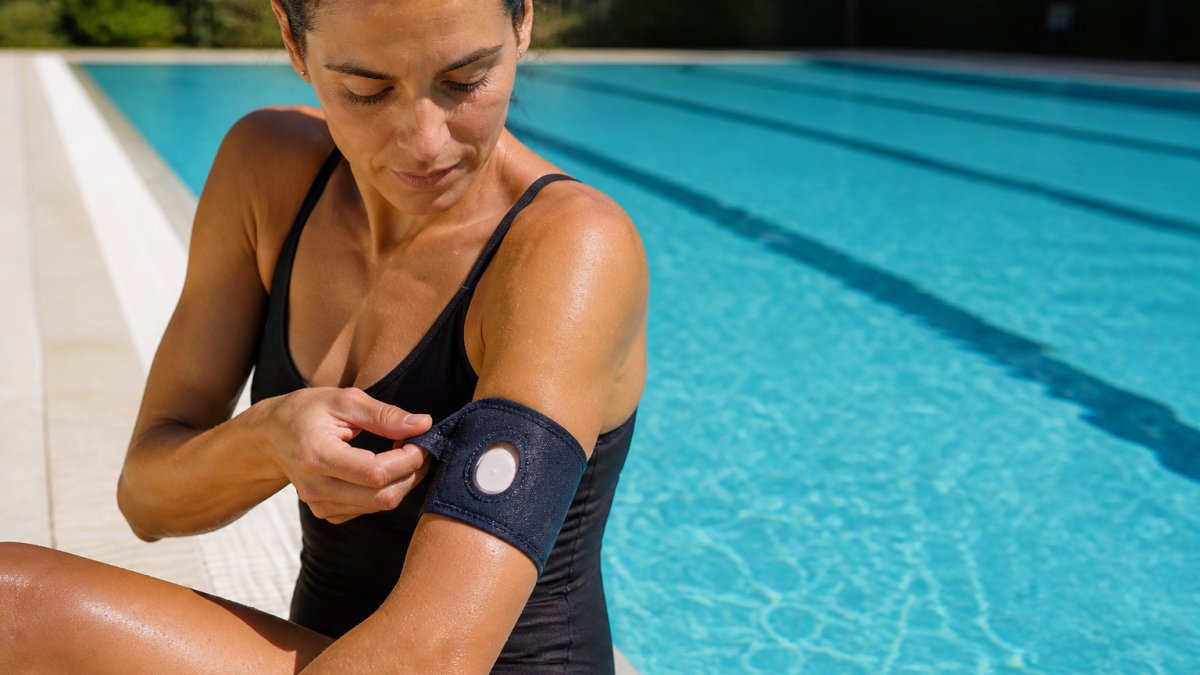
CGM Armband Fit and Sizing: Placement, Circulation and Comfort
Fit is the variable that most often decides whether an armband survives heavy swimming and CrossFit, and it is the one most guides skip. A band that is sized correctly can compensate for a mediocre material; a band that is sized wrong will fail even if the fabric is excellent.
Measure before you choose. Measure the circumference of your upper arm at the point where you plan to wear the band, not at the bicep peak. Measure both arms, because dominant-arm circumference often differs by a small but meaningful amount. Choose a size whose stated range includes your measurement near the middle of the range, not at the edge, so you have room to adjust.
Placement trade-offs. The upper arm is the usual site, but the exact position matters:
- Too high (near the deltoid): The band sits under the shoulder and can roll during overhead movements and swimming strokes.
- Too low (near the elbow): The band migrates downward during rowing, pull-ups, and sustained grip work, and the lower edge lifts.
- Mid-upper-arm, slightly posterior: This position stays out of the bar path in most lifts and is less exposed to rope and ground contact, while still allowing the sensor to sit flat.
Circulation and sensor reading trade-offs. A band that is too tight can compress the tissue around the sensor, which may affect comfort and, in some cases, the sensor’s ability to read interstitial fluid reliably. A band that is too loose will rotate and let the adhesive edge lift. The practical test is to slide one finger under the band at rest: if it will not fit, the band is likely too tight for a long workout; if two fingers fit easily, it is likely too loose for swimming.
Material and skin sensitivity. Bands worn for long sessions and rinsed repeatedly should use materials that dry quickly and do not trap moisture. Neoprene and similar closed-cell foams hold water and can soften over repeated soakings; woven elastics and quick-dry fabrics recover better but may stretch more over time. If you have sensitive skin, a band that holds a wet layer against the arm for hours is a common source of irritation, so drying time is a fit issue as much as a comfort issue.
If you swim and do CrossFit on the same day, size for the tighter of the two activities and adjust the closure between sessions rather than buying two bands. Recheck the fit after the first ten minutes in the water, when the material has absorbed what it will absorb.
Fit is a three-part decision: measure the mid-upper-arm circumference, place the band slightly posterior and mid-arm, and confirm the closure holds after the material is wet. Get those right and the material and closure have a chance to do their job.
Your Next Step: Choosing an Armband and Checking Sensor Water Ratings
Before buying, confirm your sensor model’s water-resistance rating and choose an armband designed for your device. Libre Shield provides sensor saver armbands designed to keep CGM sensors secure during daily activity. Pricing depends on quantity, dates, and delivery, so check the Libre Shield website for current prices or a quote.
Frequently Asked Questions
Can you wear a CGM when swimming?
Many CGM sensors are water-resistant, but water resistance differs by model, and the rating usually applies to the sensor itself rather than to any protective armband. Check your specific sensor’s manufacturer guidance before swimming, and treat an armband as added retention and protection rather than as a waterproof rating. Children’s Health notes that not all CGMs share the same water resistance, so confirm your device’s limits with your diabetes care team or the manufacturer.
Which CGM armband stays secure during swimming and CrossFit?
No independent head-to-head testing of CGM sensor armbands under heavy swimming or CrossFit conditions was available when this guide was written, so no armband can be confirmed as the most durable from published data. Judge candidates on the criteria covered in this guide: fabric and stitching quality, elastic recovery after repeated wet and dry cycles, a secure adjustable fit, and how well it holds through overhead and high-impact movement. Ask the manufacturer for any wear-testing they have performed and whether the armband is designed for swimming or only for light activity.
How should I size a CGM armband?
Measure the upper arm at the spot where you normally wear the sensor, then choose a size that fits snugly without cutting into the skin. The band should hold the sensor flat and stable while leaving room for circulation, so you should be able to slide a finger under it. Re-check the fit after you start sweating or swimming, because skin and fabric can shift. If your sensor sits on the back of the upper arm or the thigh, confirm the armband size fits that placement before buying.
