Table of Contents
- Why Sensors Detach During Heavy Swimming
- How to Prevent CGM Sensor Peeling Before You Get Wet
- Best Adhesive Patches for CGM: What to Look For
- CGM Sensor Armband for Swimming: Do You Need One?
- How to Secure Libre Sensor During Heavy Swimming: Step-by-Step
- Chlorine vs. Saltwater: What Swimmers Need to Know
- Post-Swim Sensor Care and Removal Techniques
- Common Mistakes to Avoid
- Frequently Asked Questions
Last Updated: September 30, 2026
Why Sensors Detach During Heavy Swimming
Continuous glucose monitors fail in water for one core reason: adhesive breaks down faster than the sensor’s electronics do. That’s the short answer. The waterproof housing usually holds up fine. The glue underneath it doesn’t.
FDA guidance on continuous glucose monitor labeling
Adhesive Failure Causes: Heat, Moisture, and Friction
Three forces work against your sensor every time you swim.
- Heat. Warm water softens the adhesive bond.
- Moisture. Water seeps under the edge of the patch and lifts it.
- Friction. Arm movement against water creates constant drag.
Water Resistance Ratings vs. Real-World Swimming
Water resistance ratings describe the sensor housing, not the adhesive. A rating tells you the electronics can survive submersion. It says nothing about whether the patch stays on your arm during a 45-minute swim set.
How to Prevent CGM Sensor Peeling Before You Get Wet
Prevention starts before the sensor ever touches your skin. How to prevent CGM sensor peeling comes down to three things: clean skin, a dry surface, and the right barrier layer.
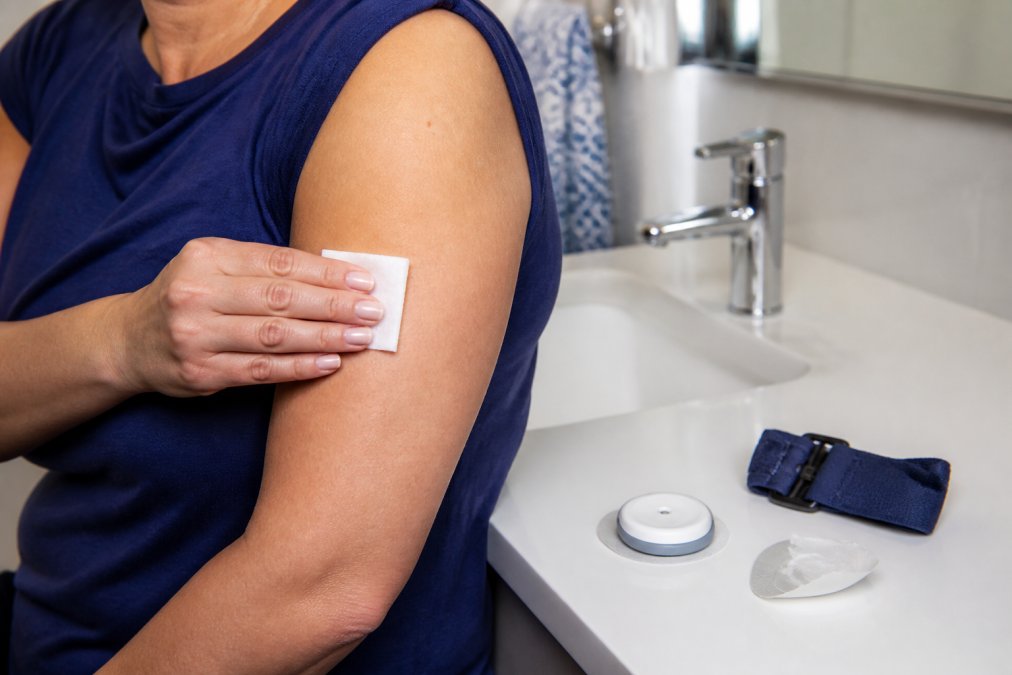
Start with these steps:
- Wash the site with mild soap and warm water.
- Rinse thoroughly and pat completely dry.
- Wipe the area with an alcohol pad and let it air dry.
- Apply a skin barrier wipe and let it set.
- Avoid lotions, oils, and sunscreen near the site.
Apply your sensor at least 12 to 24 hours before a swim session. The adhesive cures slowly, and a fully set bond resists water far better than a fresh one.
Skin Preparation That Actually Works
Skin preparation is the step most people rush. Skin barrier wipes create a thin protective layer that helps adhesive stick while reducing irritation. For sensitive skin, this layer also limits direct contact between the adhesive and your skin.
Best Adhesive Patches for CGM: What to Look For
The best adhesive patches for CGM share four traits: strong initial tack, water resistance, breathability, and a size that covers the sensor edge without pulling on skin.
| Feature | Why It Matters | Weak Patch | Strong Patch |
|---|---|---|---|
| Adhesive type | Holds under water | Standard acrylic | Medical-grade acrylic |
| Breathability | Prevents moisture buildup | Non-breathable film | Moisture-wicking fabric |
| Edge design | Stops lifting | Straight cut edges | Rounded, tapered edges |
| Size | Full sensor coverage | Barely covers sensor | Extends past sensor edge |
Never stretch a patch tight across the sensor. Over-tensioned adhesive pulls at the skin, lifts at the edges, and can distort readings if it presses on the sensor housing.
CGM Sensor Armband for Swimming: Do You Need One?
A CGM sensor armband for swimming is the most reliable hold for heavy water activity. Patches alone work for light swimming. Armbands add mechanical protection that adhesive can’t provide.
How an Armband Actually Holds the Sensor
An armband doesn’t make adhesive stick better. It changes the forces acting on the sensor. Three mechanisms do the work:
- Compression. The band presses the patch flat against the skin, so the adhesive edge can’t curl up when water flows past it.
- Shear deflection. During a freestyle pull or a flip turn, water pushes sideways against the sensor. A band absorbs that sideways load instead of letting it peel the patch.
- Impact shielding. Lane ropes, pool ladders, and the towel-dry pass all create point loads. A band spreads those loads across a wider area.
What to Look For in a Swimming Armband
Not every armband is built for water. The features that matter:
| Feature | Why It Matters in Water |
|---|---|
| Neoprene or coated elastic | Holds shape when saturated; bare fabric stretches and slips |
| Wide band (roughly 2 to 3 inches) | Distributes pressure so it doesn’t dig in or pinch the sensor |
| Adjustable hook-and-loop closure | Lets you re-tension after the band takes on water |
| Open window or low-profile pocket | Keeps the sensor readable without pressing on the housing |
| Flat seams | Reduces chafing during long sets |
When an Armband Is the Wrong Choice
Armbands aren’t universal. Skip them if:
- You’re doing a short, low-intensity swim where a well-applied patch is enough.
- You have a skin sensitivity to compression or a healing site that shouldn’t be pressed.
- Your sensor is on a site the band can’t wrap cleanly, like the abdomen.
For competitive swimmers, the armband also has to clear the stroke path. A band that sits too far forward on the upper arm catches water on the recovery phase and adds drag. Position it on the back of the upper arm, aligned with the sensor, so the band and sensor share the same low-drag profile.
How to Secure Libre Sensor During Heavy Swimming: Step-by-Step
Follow these steps in order for the strongest hold.
- Prep the site. Wash, dry, and wipe with alcohol. Let it air dry fully.
- Apply the barrier wipe. Let it set until tacky, not wet.
- Place the sensor. Press down for a full 30 seconds.
- Add the patch. Center it over the sensor and smooth the edges outward.
- Fit the armband. Position it so it covers the sensor without pinching.
- Wait before swimming. Give the adhesive 12 to 24 hours to cure.
- Rinse after every swim. Fresh water removes chlorine and salt residue.
Expected result: A sensor that stays put through laps, turns, and dry-off.
Sensor Placement Optimization for Drag Reduction
Placement affects both hold and comfort. The back of the upper arm works well because it stays out of the main stroke path. That reduces drag and limits direct water pressure on the sensor edge.
Chlorine vs. Saltwater: What Swimmers Need to Know
Chlorine and saltwater attack adhesive differently. Chlorine breaks down many adhesives chemically. Saltwater leaves a residue that can lift patch edges as it dries.
How Chlorine Attacks the Patch
Pool water is typically maintained at a free chlorine range that’s aggressive enough to oxidize organic material, including the polymers in many pressure-sensitive adhesives. The failure mode is chemical, not mechanical:
- The adhesive’s tack softens over repeated exposure.
- The patch edge loses grip first, usually within the first few swims.
- Once the edge lifts, chlorinated water wicks underneath and accelerates the breakdown.
How Saltwater Attacks the Patch
Saltwater’s failure mode is physical and residue-driven:
- As water evaporates, salt crystals form at the patch edge.
- Those crystals act like tiny wedges, prying the adhesive up from the skin.
- Salt residue also leaves a film that blocks fresh adhesive from re-bonding if you try to press the edge back down.
Saltwater failure often shows up after the swim, not during it. The patch looks fine in the water and lifts an hour later once the skin dries.
What This Means for Your Routine
| Environment | Primary Failure Mode | Timing | Best Defense |
|---|---|---|---|
| Chlorinated pool | Chemical breakdown of adhesive | During and after repeated swims | Fresh-water rinse immediately after exit; replace patch on a schedule, not on failure |
| Saltwater ocean or bay | Crystal wedging at edges | After the swim, as skin dries | Fresh-water rinse, then inspect and re-press edges while skin is still damp |
| Heated pool or hot tub | Heat softening plus chlorine | Fast, often within one session | Shorter exposure; re-tension armband after exit |
Rinsing with fresh water immediately after every swim is the single best defense against both. Skip the rinse, and residue keeps working on the adhesive long after you leave the water.
A Note on Heated and Bromine-Treated Water
Heated pools and hot tubs combine two stressors: warm water softens adhesive, and the sanitizer, chlorine or bromine, keeps working on the bond. Bromine is common in some spa and indoor pool settings and behaves similarly to chlorine against adhesives. If your training includes hot tub recovery, plan on shorter patch life and inspect the sensor before every session.
CDC guidance on recreational water and pool chemicals
Post-Swim Sensor Care and Removal Techniques
Post-swim care extends sensor longevity. Rinse, pat dry, and check every edge of the patch. If an edge has lifted, press it back down while the skin is dry.
Heavy-Duty Adhesive Removal Without Skin Damage
Heavy-duty adhesive needs patience, not force. Pulling a patch straight off can strip skin and leave adhesive residue behind.
Use this method:
- Soak the patch edge with adhesive remover or warm water.
- Wait a full minute for the adhesive to soften.
- Peel slowly, keeping the patch flat against the skin.
- Wipe away residue with an oil-based remover.
- Wash the area and apply moisturizer.
The strongest hold comes from a system, not a single product. Barrier wipe, patch, and armband each handle a different failure point.
Common Mistakes to Avoid
Most detachment problems trace back to a handful of errors.
- Swimming within hours of applying a new sensor.
- Applying over lotion, oil, or sunscreen.
- Skipping the alcohol wipe and barrier layer.
- Using a patch that barely covers the sensor edge.
- Drying the site with hot air.
- Reusing the same spot without rotation.
- Pulling patches off without softening the adhesive first.
Frequently Asked Questions
How long can you submerge a FreeStyle Libre sensor?
FreeStyle Libre sensors carry an IP28 rating, meaning they can withstand submersion in up to 1 meter of water for up to 30 minutes. For heavy swimming or extended pool sessions, this window may not be enough. Using a CGM sensor armband for swimming adds a physical barrier that helps keep the sensor housing secure, reducing the risk of water infiltration and sensor detachment during longer workouts.
Do I need an armband to keep my CGM secure while swimming?
An armband is not required, but it significantly reduces sensor detachment during heavy swimming. Adhesive alone can fail when exposed to prolonged moisture, heat, and friction from arm movement. A CGM sensor armband for swimming holds the sensor flat against your skin, preventing edges from lifting. For high-intensity swimmers or those who swim multiple times per week, an armband combined with a quality adhesive patch provides the most reliable protection.
What are the best adhesive patches for CGM sensors?
The best adhesive patches for CGM are designed for water resistance. Look for patches that maintain grip. Avoid patches that cover the sensor’s transmitter entirely, as this can affect Bluetooth connectivity. Patches with pre-cut centers that fit around the sensor housing work best for swimming because they seal the edges without interfering with readings.
How do I prevent CGM sensor peeling during heavy sweating and swimming?
Start with clean, dry skin. Use an alcohol wipe, then apply a skin barrier wipe to create a protective layer that helps adhesive bond better. Let it dry completely before applying the sensor. After the sensor is on, apply a waterproof adhesive patch over it, pressing down firmly for 30 seconds. For extra security during heavy swimming, add a sensor armband over the patch. Avoid lotions or oils near the site, as these break down adhesive and cause peeling.
Heavy swimming puts real stress on any CGM setup, and adhesive alone often isn’t enough. Libre Shield builds sensor saver armbands that hold your device securely through laps, turns, and daily activity, with protection designed for people who rely on their CGM every day. Explore the Libre Shield armband range to see how a dedicated hold keeps your sensor in place and your readings steady.